
In Houston, getting arrested for DWI is a shock you don’t forget. What started as a night out turns into handcuffs, a tow bill, and a court date – and suddenly you’re worrying about your job, your driver’s license, and how you’re going to explain all of this to the people in your life. It can feel like the whole case is already lost the minute somebody blurts, “I’m drunk,” or jokes that they’ve “always been the drunk one” after a long night.
Under Texas law, it doesn’t work that way. See Texas Penal Code §49.04. Texas state has to prove that you were:
- operating a motor vehicle
- in a public place
- while intoxicated
They have to prove your state of intoxication while you were driving. Every stage specific rules: the stop, the detention, the tests, the video, the lab work, and what happens in court.
Your criminal DWI case is on one specific track. Your driver’s license runs on a completely separate track through the Texas Department of Public Safety (DPS).
15 days from the date you get the notice of suspension you have to request an Administrative License Revocation (ALR) hearing. If your case involved a blood draw and DPS later mails you a Notice of Suspension after the lab result comes back, you have 20 days from the date on that letter to request the hearing. Miss that window and your license will almost certainly be suspended.
Even if a suspension does happen, many drivers can apply for an Occupational License that lets them drive for work, school, and basic household needs. You can’t operate anything that requires a CDL, but it can help you keep going to work and continue taking care of your family’s needs. Keep in mind, though, it’s still easier to fight a suspension up front than to fix one later.
Quick links to our 6 supporting Houston DWI Guides:
What to do in The First 72 Hours After a Houston DWI Arrest
The first few days after an arrest are hectic, take your time to mentally rejuvenate, but also consider this is when you can still grab evidence that can disappear quietly if you don’t ask for it.
Things that actually help:
- Calendar your ALR deadline.
- Ask your lawyer to request dash-cam, body-cam, and station/intox-room video before it’s overwritten.
- Write out a timeline of the day: where you were, when you drank, things you ate, any medications you took, who saw you, and when.
- Make a list of witnesses that can help your case– friends, coworkers, bartenders, Uber/Lyft drivers – and what they can honestly say about how you looked and acted.
- List out any medical problems you experience.
Consider that your case is already in the Harris County Criminal Justice Center at 1201 Franklin. These early discovery requests and specifically targeted motions are what turn a potentially hopeless case into one that can be dismissed, reduced, or won completely.
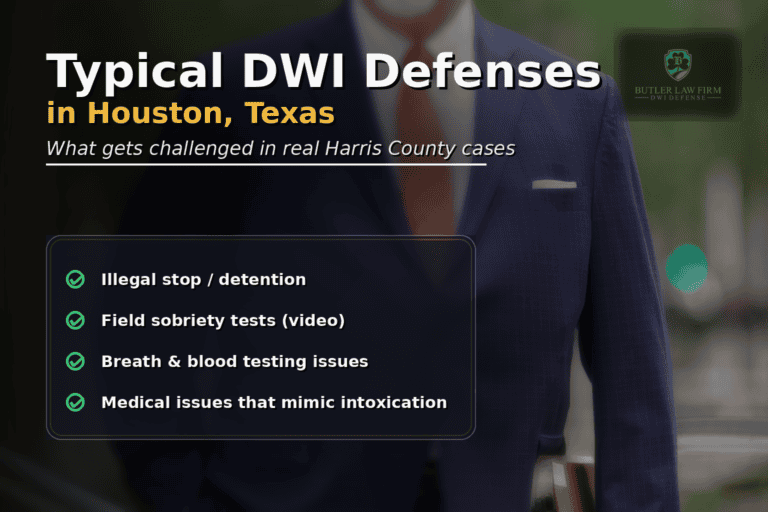
Defense #1: Was the Stop Legal?
Every DWI case starts with some sort of encounter:
- Getting Pulled over (speeding, running a red light or stop sign, failure to signal)
- An accident
- A parking-lot “welfare check”
A large part of defending your case around Houston is asking this question:
Did the officer really have a REAL lawful reason to stop and detain you?
Additional items that can help your case:
- Any driving that looks normal on video compared with the dramatic description in the police report.
- People giving 911 tips about a “drunk driver” that don’t get backed up by the officer’s own observations.
- Longer gaps between the traffic violation and the actual pulling over.
- A simple welfare check on a parked car that turns into a full DWI investigation with no new facts in between.65
If a judge decides that any part of the stop violated the Fourth Amendment or any laws within Texas, including what happens afterward – for example: your statements, sobriety tests, and even the breath or blood result – can work to be suppressed. When they can’t use the main evidence involved in the case, your case being dismissed and being offered a better plea offer becomes more realistic.
Defense #2: Field Sobriety Tests on Video
The roadside tests are what most people remember:
- Watching a pen or light with your eyes (HGN)
- The good ol’ heel to toe walk.
- Standing on one leg and counting
More so now in Houston DWI cases, these tests live and die both on video. The officer’s written report is one story. The dash-cam and body-cam are another.
On those videos, your lawyer will be watching for details like:
- Instructions given too fast or not fully demonstrated.
- Any unfavorable conditions like: uneven pavement, rain, wind, heavy, or poor lighting.
- No understanding of medical issues that can make the tests completely unfair.
The video footage from the Station/intox-room can also show if the officer rushed through things, bypassed certain questions, or if you received treatment that doesn’t later correlate fully to the report.
Defense #3: Challenging the Breath Test
If you blew over the legal limit, it’s not the end of your story. The machines can display errors. It has to be operated correctly, and the device has to be regularly cleaned and maintained.
Things a Houston DWI lawyer will look at:
- Were there any interruptions in the 15 minute observation period?
- Do you have a medical condition that can cause “mouth alcohol” spikes?
- Is the machine taken care of to produce a proper result? Do the maintenance logs, solution changes, and simulator temperature checks reflect that the device was working the way policy requires?
- Are the built-in assumptions (like partition ratios and uncertainty ranges) being considered exact truth instead of estimates based on the machine’s capabilities?
Sometimes the bigger issues are legal rather than scientific:
- Were the DIC-24 statutory warnings stated correctly?
- All the forms filled out completely?
- Were all local law procedures followed on offering and running the test?
Even one of those issues can give you leverage for your case. It can help the judge not consider the breath alcohol to carry as much weight because all these things are vital to produce an accurate breath test.
Defense #4: Blood Testing – Warrant, Handling, and the Lab
Blood tests look “more scientific,” but it alot still depends on people and systems that can end up making mistakes.
Common points working to get your case dismissed with blood testing:
- The warrant: Was the warrant valid? Did it lay out facts or rely too heavily on vague language? Was it signed based on up-to-date information?
- Collection: Was the correct tube used? Did it have the proper preservatives to keep it untampered? Was the blood stored and transported properly?
- Chain of custody: Does the paperwork show who handled the sample, where it went, and when – without unexplained gaps where it could have been altered?
- Lab work: Do the lab’s calibration records, quality-control runs, and chromatograms suggest contamination, carry-over, or instrument issues?
In certain situations, an independent retest and a thorough cross-examination of the analyst can help evolve a bad BAC into something a jury is not sure they can fully trust.
Defense #5: Rising BAC and Retrograde Extrapolation
Prosecutors often try to guess what your alcohol level would’ve been at the time of driving, using their test that was taken later. This is called retrograde extrapolation, and it calculated with a lot of assumptions, including:
- How long from your last drink
- How much you drank
- What you ate and when
- Your body stature
If any details are confusing or missing, the State’s expert is working inside a range, not calculating an exact number. That uncertainty can be enough to create reasonable suspicion about whether you were actually over the legal limit when you were behind the wheel.
Defense #6: Medical Conditions That Mimic Intoxication
Not every “clue of intoxication” comes from alcohol or drugs or inducing intoxication in some way. In real-world Houston DWI cases, medical issues often play a role. For example:
- Diabetes / ketosis can result in fatigue, confusion, and unusual breath odor.
- Neurological conditions can sometimes cause natural nystagmus (jerky eye movements) or balance problems.
- Inner-ear and orthopedic problems can result in standing, turning, and walking heel-to-toe difficult even when sober.
- Anxiety or panic attacks can inhibit speech, breathing, eye contact, and the ability to follow multi-step instructions.
- GERD and serious acid reflux can push alcohol back into the mouth and interfere with breath-test results.
Having medical records showing your condition helps immensely. Medical records, prescription history, and it can help to have an expert testimony to show the judges and juries to help them understand there may be a real medical explanation for how you looked and performed on with those standardized tests.
Harris County Options: PTI, Deferred Adjudication, and Local Practice
In Harris County, “winning” a DWI doesn’t always mean a not-guilty verdict. There are local agencies that report that can matter just as much for your long-term criminal history record:
- Pre-Trial Intervention (PTI):
In specific first-offense DWI cases, prosecutors may offer a PTI program. If you’re approved and complete the program, including staying out of trouble, your case can be dismissed at the end of the program. - Deferred adjudication:
You can apply for a qualification to have your DWI case placed on deferred adjudication community supervision instead of entering an immediate conviction. If approved, you can then be eligible for an order of nondisclosure under Texas Government Code provisions, which seals the case from most public background checks that employers might run (obviously, with exceptions for law enforcement and certain agencies).
Whether you happen to be approved for PTI or deferred adjudication depends completely on your record, your BAC, if a crash or injury was involved, and current Harris County policy. This is where it pays off to have a DWI lawyer with 30+ years of DWI-specific law in Houston TX. Jim truly cares about all of his clients and wants the best possible outcome for them and their case.
What You Can Do Right Now
If you’re home from jail and staring at your paperwork, here’s a basic starting list:
- Confirm your ALR deadline and make sure a hearing request is being filed on time.
- Gather all of your documents: tow slip, DIC-25, temporary license, bond paperwork, hospital discharge papers, and any receipts.
- Write out a timeline from a few hours before the stop until you were released.
- Make a written list of your medical conditions and medications, plus the doctors or clinics that treat you.
- Write down names and contact information for anyone who saw you that day and what they can truthfully say about your driving, speech, and balance.
- Don’t post about your arrest on social media. Screenshots travel faster than you think.
A DWI in Houston can affect your record, your career, your insurance, and your ability to drive for years. Going through this without a local DWI lawyer is a gamble most people can’t afford.
Talk to a Houston DWI Lawyer
If you’ve been charged with DWI in Houston or anywhere in Harris County, you don’t have to figure this out alone.
➜ Call now: 713-236-8744
➜ Start here: Get a Free Case Evaluation
An experienced Houston DWI attorney can look at the stop, the tests, the video, and the lab work and tell you where the real defenses are in your case – not just on paper, but in the courtroom where it counts.