
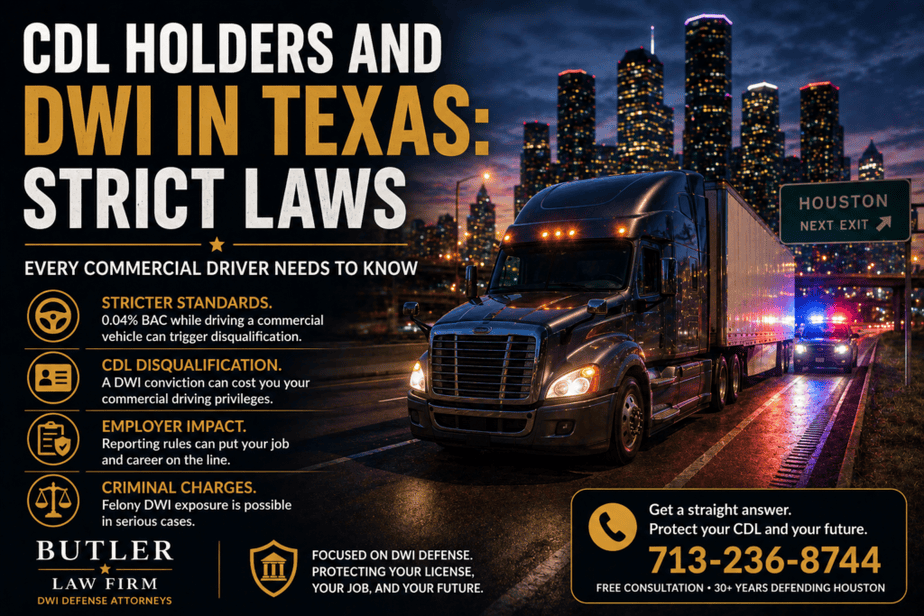
Did you just get a DWI while holding a CDL (Commercial Drivers License) in the Houston Texas area? You probably already know that this just isn’t a typical DWI case with a CDL involved.
It doesn’t matter if you were driving your own vehicle or if you were off the clock at the time of the stop. Even if nobody got hurt this could seriously have a large impact on your life and your career if your career depends on a CDL.
That’s the part a lot of people don’t see coming.
Even a normal every day driver in Texas is dealing with a huge problem after getting arrested for a DWI. But for this to happen while you are holding a CDL and depend on the income that comes in through the use of your license creates two big problems.
There is a criminal side of the case for the DWI. But there is also a completely separate issue with commercial license fallout. This can affect your ability to work under your CDL and make money for your family.
When a DWI affects not only the one that was driving, but their family too. That’s when it becomes a situation you know you can’t ignore. You’ve got to get it handled.
If you need help with your case Call the Butler Law Firm Now at: 713-236-8744
Here’s the deal. The State of Texas along with the federal rules are more aggressive on commercial drivers. Not just a little harder. A lot harder. The alcohol limits are different in some scenarios. The disqualification rules are also different. Employer notice rules are not that of a normal DWI. And the consequences with your work and employer can start before you’ve even wrapped your head around what happened that day on the side of the road when you were pulled over.
This is where many get burned.
They approach and treat a CDL DWI case like a regular first-offense DWI. That is absolutely not what it is.
The CDL Problem. Separate from the criminal case
In Texas, most adults are typically charged with a DWI, not a DUI. Under Texas Penal Code § 49.04, a DWI is defined as operating a motor vehicle in a public place while intoxicated. And per Texas Penal Code § 49.01, “intoxicated” is defined as either losing the normal use of your mental or physical faculties because of alcohol, drugs, a dangerous drug, a controlled substance, or some combination of those things, or having an alcohol concentration of 0.08 or more.
See, this is the criminal-law side for the DWI.
Retaining your CDL and keeping it in good standing is different.
Texas also has a specific commercial-license system under Transportation Code Chapter 522. Texas DPS explains the disqualification issues on its CDL disqualifications page, and DPS explains on the ALR page that a driver can be faced with either a suspension and/or disqualification after the DWI arrest if either a blood or breath test shows 0.08 or more in a non-commercial vehicle. It’s only 0.04 or more while driving a commercial motor vehicle.
Now that doesn’t mean every 0.04 case automatically matches the criminal DWI statute the same way a normal 0.08 alcohol case does.
What it means is that commercial drivers are playing by much stricter rules when it comes to the driver’s license and disqualification side.
This matters a lot more than most realize .
Because a Houston CDL case is many times not just about if the State can prove intoxication under Penal Code Chapter 49. It’s also about if DPS and the commercial-license rules are about to revoke your ability to drive for a living or not.
Strict rules start before the case ends
Commercial drivers are dealing with a tighter set of license rules from the State of Texas right from the beginning.
Texas DPS states on its ALR page that the Administrative License Revocation (ALR) process is a civil process that is completely separate from the criminal side of the case for the DWI, and that it can suspend and/or disqualify your license after being arrested for DWI if the driver either refuses or fails to complete the testing. As well if there’s a specimen provided of 0.08 or more in a non-commercial vehicle, or a specimen of 0.04 or more while driving a commercial motor vehicle.
This is highly important because a CDL case can start affecting your driving ability before the criminal case for the DWI is even resolved.
Here’s the real talk, this is why being a CDL holders and getting a DWI in Texas is a completely different conversation than handling a normal DWI case for a non commercial driver. Comparing the two – by the time a regular driver is starting to think about fines and classes, a commercial driver may already be trying to figure out if the commercial driver’s license side is about to interfere with their work and income.
So can you lose your CDL for a DWI?
Yes you absolutely can.
And sometimes the trigger is broader than drivers think.
Texas DPS states on its alcohol-related offenses page that if you have a commercial driver license and happen to be convicted of a DWI, your CDL will be disqualified. DPS also states on a separate CDL disqualifications page that alcohol-related convictions can lead to the following:
- A disqualification period of at least one year for a first offense.
- A disqualification of at least three years for a first offense while operating a commercial motor vehicle placarded for hazardous materials.
- A lifetime disqualification for a second qualifying offense.
If you read that, you realize that this is not minor at all.
It’s a “deal with it later” type of problem or one that you can ignore if you care about you and your families well being.
Here is where many can make incorrect assumptions. Often times they think the CDL only gets hit if the arrest happened in the big rig. Not always the case.
Texas DPS also warns that CDL or CLP holders can even be disqualified based on specific convictions from a personal vehicle. The DPS page for disqualifications points people back to Texas Transportation Code § 522.081 for the applicable rules.
So yes, even being in your own pickup can evolve into a disaster when it comes to keeping your CDL.
Typically this is the part nobody likes hearing, but at the end of the day, it is true.
Take the worry out of your situation knowing you have a 100% DWI focused attorney with 30+ years of experience in Houston fighting the State of Texas for you. Call the Butler Law Firm Now at: 713-236-8744
Being off duty doesn’t always save you
Now, this is probably one of the biggest myths when it comes to getting a DWI while holding a CDL in the Houston, Texas area.
Most of the time I’ve found that drivers think, “I was not in the work truck, so my CDL is be safe.”
This is not always the case, you can still be looking at issues.
If you happened to be operating a commercial motor vehicle, the 0.04 commercial BAC rule matters for disqualification.The FMCSA says that clearly on its page for the CDL standards, and Texas law folds commercial-license disqualification into Chapter 522.
If you weren’t operating your big rig and you were in your personal vehicle, the criminal side of the case for the DWI still matters. The case’s conviction can also still affect your CDL status depending on the offense that you ended up being charged with.
This means that that the question isn’t just “What was I driving?”
It’s also:
Was there a conviction?
Were there alcohol or drugs involved?
Was there a refusal?
Was there a license suspension?
Was hazmat involved in the traffic stop?
Are there any prior disqualifying offenses?
This is why a commercial driver that’s received a DWI in the Houston, Texas area shouldn’t rely on unprofessional or friendly advice from coworkers. Or the that one dispatcher who “saw a guy beat one once.” The law and rules around a DWI with a CDL are way too specific for that.
Employer and carrier problems:
This is the part that can be brutal because it can hit your job even when the case is still fresh and brand new.
Many commercial drivers are not just dealing with court system when this happens. They are also dealing with their employer’s policy, problems with fleet-insurance, pressure from dispatch, the safety departments, and the simple fact that carriers work to avoid uncertainty.
I am trying to be careful with the wording here. Your employer disclosure rules can come from the company policy, the carrier requirements, or the specific licensing issue that is in play. So you really don’t want to guess on this.
Read all of your handbooks. Read any and all notices you got from DPS. And, perhaps most importantly, don’t assume that your work will stay separate from the DWI case.
If job fallout is your biggest fear, Butler already has related pages on getting a job with a DUI charge on my record and how long does Houston DWI stay on your record.
Or if you feel that you just need help to achieve the best possible outcome, Call Butler Law Firm now: 713-236-8744.
Houston, Texas makes the commercial license side harder
A normal driver’s license suspension is bad enough in Houston.
But a commercial driver’s license disqualification is even worse as it affects your ability to make income for you and your loved ones.
Even if your license is suspended, you still have Harris County court dates you’ve got to attend. How are you going to get downtown? You still have to deal with your family, all of the bills, and everyday regular life. So, in the case that you make money being behind the wheel, the pressure is pretty much immediate.
Texas DPS states that the Administrative License Revocation program is a separate civil process from the criminal case. This means that a driver can be fighting a DWI case in court while the driver’s license side is moving completely on its own and can get bad quickly if neglected.
So there’s two different clocks running for you now.
This is where people often get overwhelmed.
If you’re trying to save your driving privileges, Butler Law Firm has mapped this all out for you. Here are some links from our law firm that just might be helpful to you right now:
- ALR hearing Texas
- Addressing administrative license revocation in Houston,
- Keeping your license after a DWI charge
- How to prevent a suspended license following a DUI.
Another thing many drivers can miss: getting an occupational license is not always a fix for everything.
Texas DPS states on its page for occupational driver licenses that an occupational license authorizes the operation of a non-commercial motor vehicle only, and it cannot be issued for the purpose of operating a commercial motor vehicle during a period of suspension, revocation, cancellation, disqualification, or denial.
That’s a real kicker especially if one has hope through this route while trying to be able to remain working and making money if you drive for a living.
This means even if you can get limited personal driving privileges, that does not mean you are legally back in the truck.
This is where cases turn for commercial drivers. A lot of them think that even having some kind of restricted license means they can somehow keep working. The seriousness is often not realized. And that is not how it works for a suspended or a disqualified CDL.
Drugs and prescription medication can wreck a CDL case too
Some drivers still think DWI is mainly an alcohol problem.
Not in Texas.
Under Penal Code § 49.01, intoxication can be based on drugs, dangerous drugs, controlled substances, or combinations. So yes, a commercial driver can face a DWI allegation tied to marijuana, cocaine, pain medication, sleep medication, or some ugly mix of substances.
And those cases can be messy.
Sometimes the officer says the driver looked impaired, but the real issue is exhaustion, injury, illness, or a medication interaction. Sometimes the blood result does not answer the timing question nearly as cleanly as the report suggests. Sometimes the whole case leans too hard on a one-sided story from the stop.
That is why drug-related CDL cases need careful work. They are not always as obvious as the arrest paperwork tries to make them sound.
For that side of the topic, Butler has related pages on DUI for drugs and what you need to know and all about drug DUI charge in Houston.
The record damage is not just about court
Commercial drivers know this already, even if they do not want to say it out loud.
A DWI record hits differently when your work depends on trust, insurance, and compliance.
It is not just a fine. It is not just a class. It is not just whether you can stay out of jail.
It is whether a carrier wants to keep you. Whether another company will hire you later. Whether a safety department sees you as a risk. Whether insurance gets tighter. Whether a year out of the truck turns into something longer.
And because Harris County court records and license issues are not private in the way people wish they were, that pressure can follow you around.
This is also why Texas trucking laws and DWI violations become career issues so fast. Commercial drivers do not have the luxury of pretending the case only matters on court day.
What should a CDL holder do right after a Houston DWI arrest?
Not everything. Just the right things.
Start here:
- Read every paper you were handed and watch the ALR timeline closely.
- Do not assume your CDL problem only exists if you were in a semi.
- Do not assume an occupational license lets you drive commercially.
- Do not blow off employer notice issues and hope they disappear.
- Save bond paperwork, tow paperwork, notice forms, and any test paperwork.
- Stop talking about the case like you already know what the blood result proves.
- Talk to a Houston DWI lawyer before you make job or license decisions that lock you in.
That is the practical list.
Because the real danger is not just the arrest. It is the bad decisions people make in the first week after the arrest.
Here is what matters
CDL holders and DWI in Texas: strict laws is not just a scary headline. It is real.
Commercial drivers face tougher alcohol rules in commercial vehicles, serious disqualification exposure after certain convictions, employer notice obligations, and no easy workaround through an occupational license when the goal is to keep driving a commercial rig.
And yes, a DWI conviction from a personal vehicle can still create CDL trouble.
That is why these cases feel so much heavier than a normal Houston DWI case.
You are not only trying to protect your record. You are trying to protect your ability to work.
If you want a straight answer on your case, call 713-236-8744 or reach out through Butler Law Firm’s free case evaluation.
If your license is your livelihood, you should treat the case that way from day one.